Event-Driven Car Loan Planner: Turning a First Car Loan into a Lesson in Financial Discipline
OBJECTIVE: One of the best financial lessons isn't taught in school, it's learned with a first car loan.
I created this Event-Driven Car Loan Planner to help my daughter see how every payment decision affects both interest costs and long-term credit history. Rather than making only the required monthly payments, I designed a financial model that demonstrates how payment timing, additional principal payments, and disciplined planning can reduce lifetime interest while establishing a strong payment history.
The workbook combines financial modeling, dashboard reporting, and forecasting into an interactive planning tool that allows users to compare an optimized payoff strategy with actual payment activity while continuously projecting future interest savings.
PROJECT GOALS:
Model a real-world daily simple-interest auto loan
Demonstrate how payment timing affects lifetime interest
Compare planned payments versus actual payment activity
Forecast remaining interest after every payment
Build an educational financial planning tool using Excel
TECHNICAL HIGHLIGHTS:
Financial Modeling:
Daily simple-interest calculations using actual calendar days
Interest-first payment allocation
Event-driven amortization schedule
Dynamic payoff calculations
Forecast engine that recalculates after every payment
Dashboard Development:
Planned payoff strategy
Actual payment progress
Baseline interest savings
Additional savings from early payments
Total projected interest savings
Balance and cumulative interest charts
Excel Techniques:
Nested IF formulas
INDEX / MATCH lookups
Dynamic named ranges
Conditional formatting
Event-driven calculations
Forecast modeling
Dashboard visualization
User-friendly workbook architecture
BUSINESS CHALLENGE:
Traditional amortization schedules assume every payment is made exactly as planned.
Real borrowers often:
Pay early
Pay late
Make additional principal payments
Change payment amounts
Most loan calculators cannot accurately project the financial impact of these real-world payment behaviors while preserving lender servicing rules.
SOLUTION:
Designed a multi-sheet Excel workbook that separates planning, execution, reporting, and forecasting into distinct calculation engines.
The workbook:
Creates a baseline 12-month payoff strategy
Records actual payment events independently
Measures additional lifetime interest savings created by payment timing
Forecasts remaining interest using the latest actual payment information
Preserves lender servicing assumptions such as daily simple interest and non-advancing due dates
WORKBOOK ARCHITECTURE:
README - User guide, assumptions, documentation, and workbook overview
INPUTS - Loan assumptions and baseline payoff strategy
PLANNED EVENTS - Baseline amortization schedule and interest calculations
ACTUAL EVENT LOG - Records actual payment activity and principal reductions
DASHBOARD - Visual summary comparing planned and actual results
FORECAST ENGINE - Projects remaining interest and payoff based on latest actual payment
KEY FEATURES:
Event-Driven Architecture
Instead of relying on a fixed amortization schedule, every payment becomes a financial event that updates all downstream calculations.
Forecast Engine
Projects:
Remaining interest
Updated payoff balance
Final payoff payment
Additional lifetime interest savings after every recorded payment
Interest Savings Analysis
Separates savings into two categories:
Baseline Strategy Savings
Interest saved by following the optimized 12-month payoff strategy instead of the original loan disclosure.
Additional Lifetime Interest Savings
Additional projected savings (or losses) created by actual payment timing and payment amounts.
Educational Design
Beyond simply calculating payments, the workbook demonstrates how disciplined financial decisions influence:
Interest expense
Principal reduction
Payoff timing
Credit-building through consistent monthly payments
CHALLENGES & SOLUTIONS:
⚠️ Challenge 1: Traditional amortization schedules assume fixed monthly payments.
✅ Solution: Created an event-driven calculation engine that recalculates interest using actual calendar days between payment events.
⚠️ Challenge 2: Borrowers frequently pay different amounts on different dates.
✅ Solution: Separated planned payments from actual payments, allowing real payment history to be tracked independently.
⚠️ Challenge 3: Many auto lenders apply payments differently than consumers expect.
✅ Solution: Modeled verified servicing rules including:
Daily simple interest
Interest-first payment allocation
Non-advancing due dates
Exact payoff adjustment
⚠️ Challenge 4: Borrowers rarely understand the financial impact of paying early.
✅ Solution: Built a forecasting engine that continuously projects future interest and quantifies additional savings after every payment.
SKILLS DEMONSTRATED:
Financial Analysis
Loan modeling
Interest forecasting
Scenario analysis
Cost optimization
Excel
Advanced formulas
Dynamic dashboards
Financial modeling
Forecast calculations
Workbook architecture
Data Visualization
Executive dashboard
KPI reporting
Trend charts
Balance projections
RESULTS:
Built a fully event-driven financial planning workbook from scratch.
Reduced projected interest expense by more than $2,100 compared to the original loan disclosure.
Developed a forecasting engine that recalculates projected lifetime interest savings after every recorded payment.
Created a reusable financial model that balances accelerated debt repayment with the goal of establishing a strong first-year payment history.
Turned a real first-car purchase into a practical lesson in budgeting, credit-building, and disciplined financial decision-making.
VISUAL WALKTHROUGH: The following workbook pages illustrate the complete solution architecture. Explore the loan setup, event-driven calculations, dashboard reporting, and dynamic payoff forecasting.
Click on any image to enlarge it to full screen.
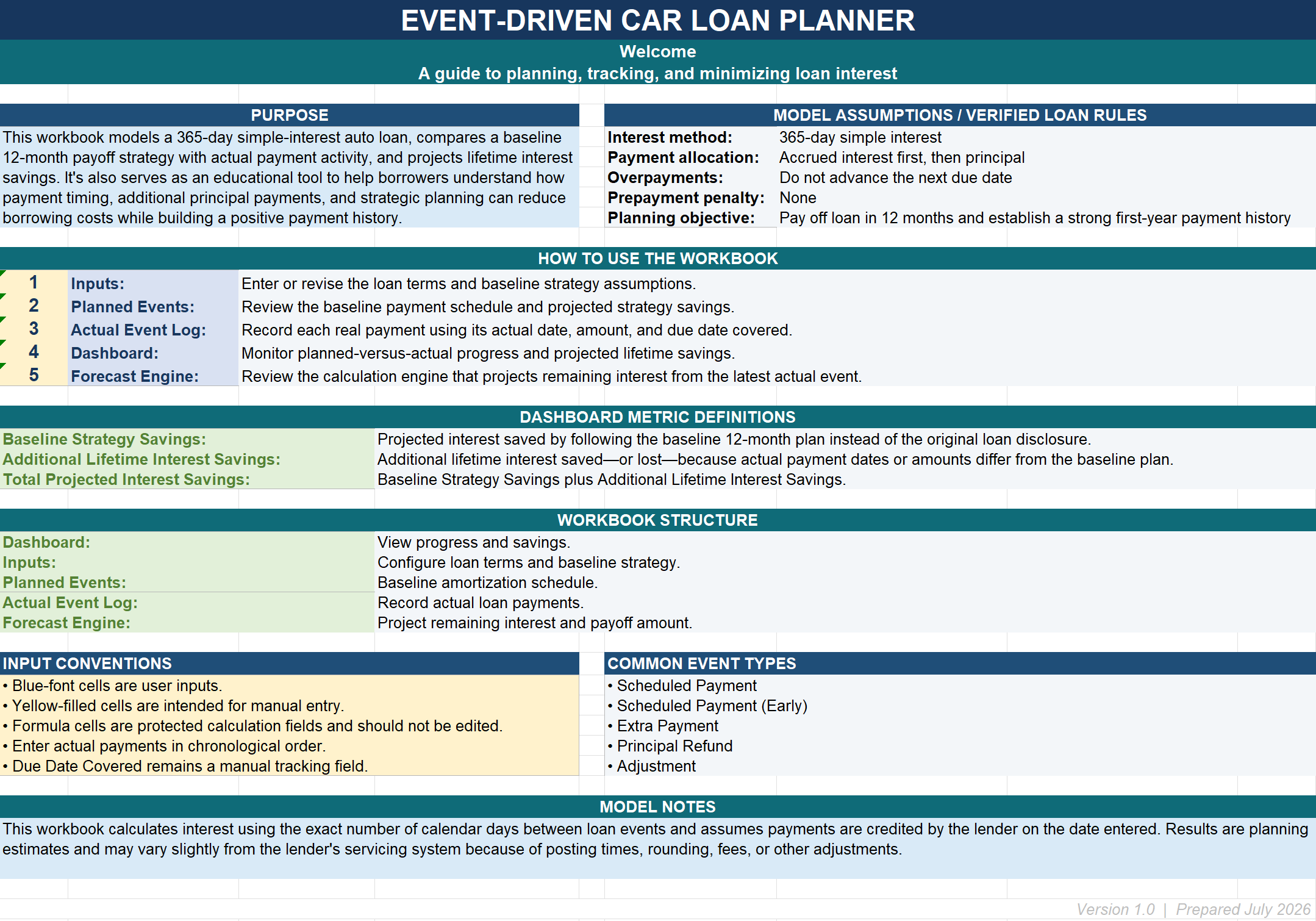
Every project benefits from strong documentation. The README introduces the workbook's purpose, explains the underlying financial model, defines key metrics, and provides clear instructions so users can confidently navigate the workbook and understand the calculations behind it.
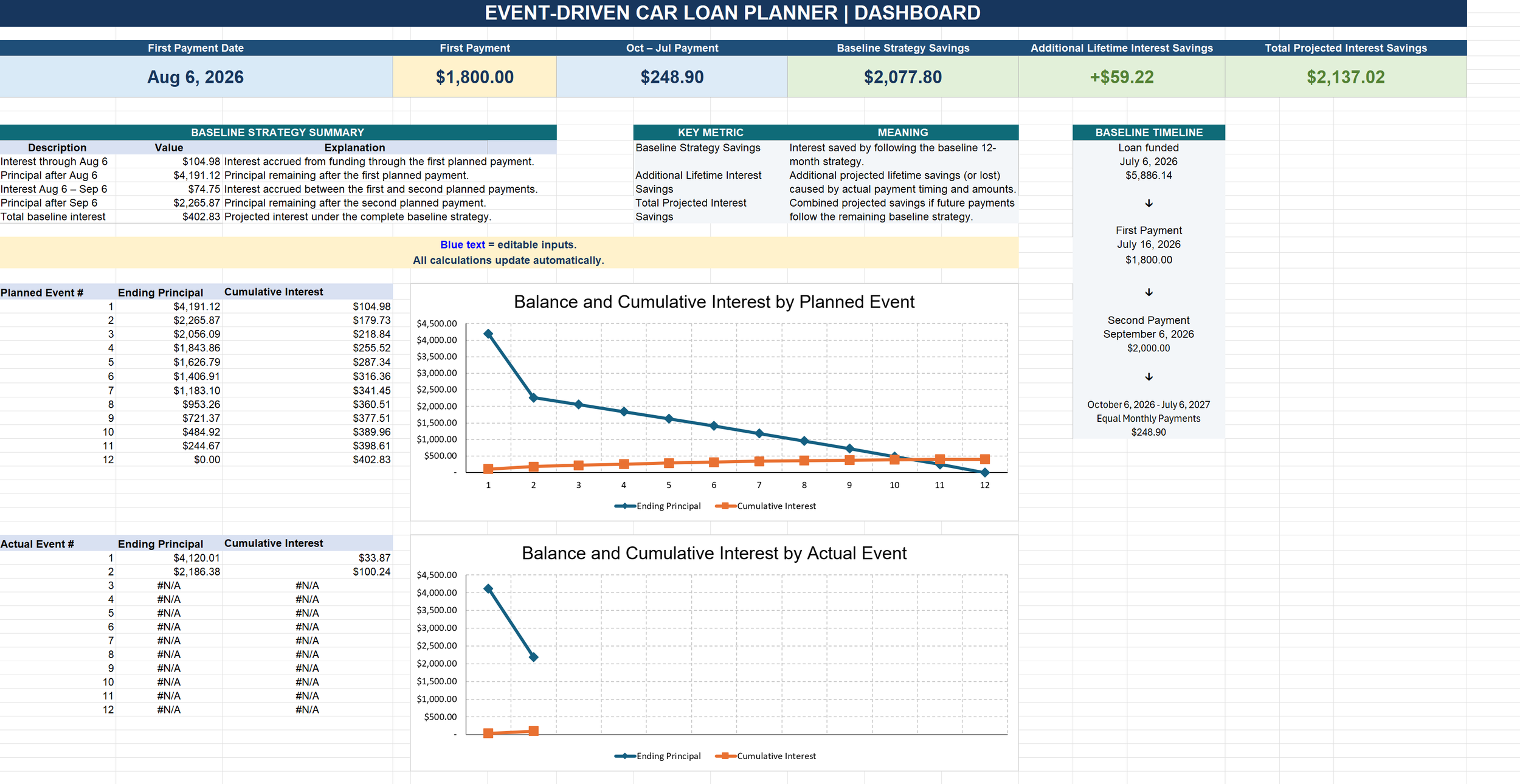
The dashboard provides an executive summary of the loan strategy by combining key performance indicators, projected interest savings, payment milestones, and visual trends into a single view. By comparing the baseline payoff strategy with actual payment activity, users can quickly monitor progress, evaluate financial outcomes, and make informed payment decisions.
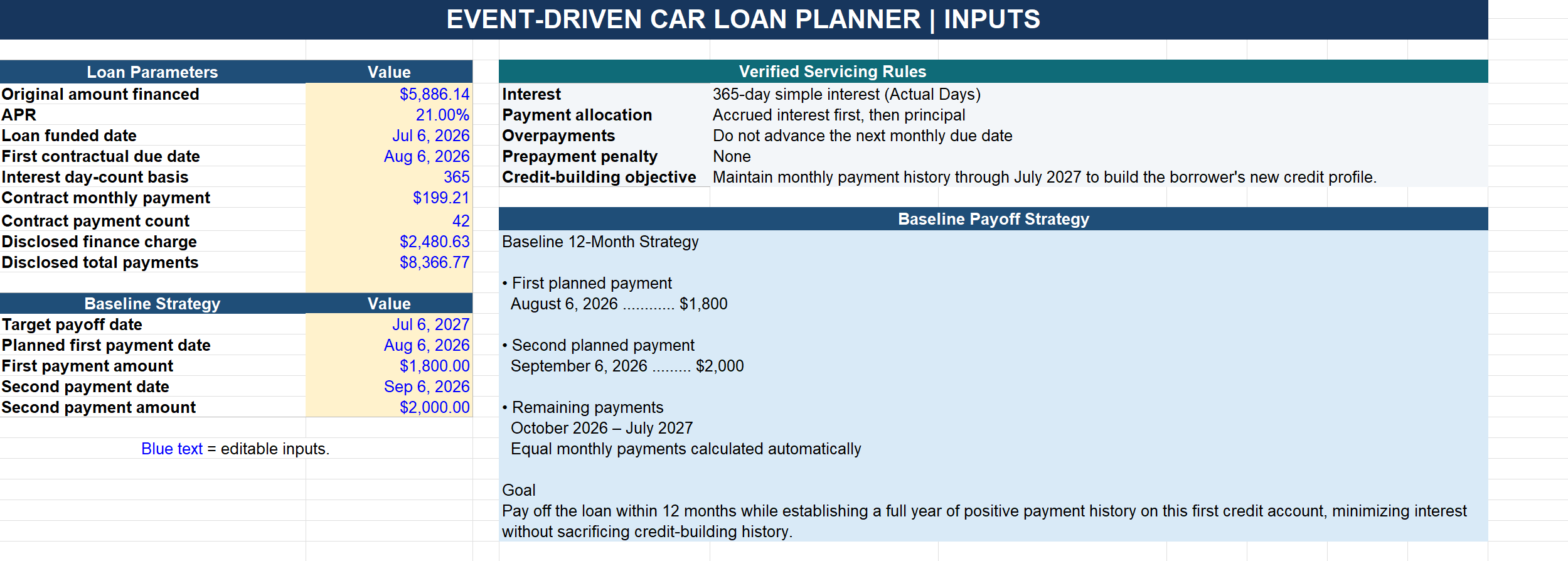
The Inputs worksheet serves as the workbook's configuration hub, allowing users to define loan parameters, review verified servicing rules, and establish a baseline payoff strategy. Separating assumptions from calculations improves transparency, flexibility, and maintainability while allowing the entire workbook to update dynamically as inputs change.

The Planned Events worksheet serves as the workbook's financial modeling engine, calculating daily simple interest, payment allocation, principal reduction, and ending balances for the baseline 12-month payoff strategy. By modeling each payment as a separate financial event, the workbook provides a transparent and flexible framework for analyzing interest savings and supporting downstream reporting and forecasting.
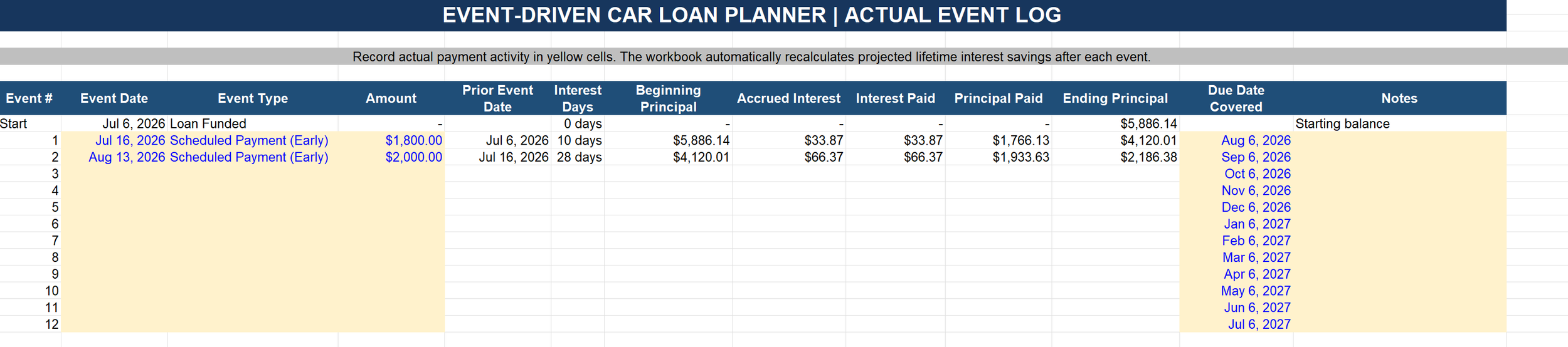
The Actual Event Log captures real payment activity as it occurs, recording payment dates, amounts, and due dates covered while automatically recalculating interest, principal reduction, and remaining loan balance. By separating planned payments from actual payment activity, the workbook provides a flexible framework for tracking progress, measuring payment performance, and supporting accurate forecasting.
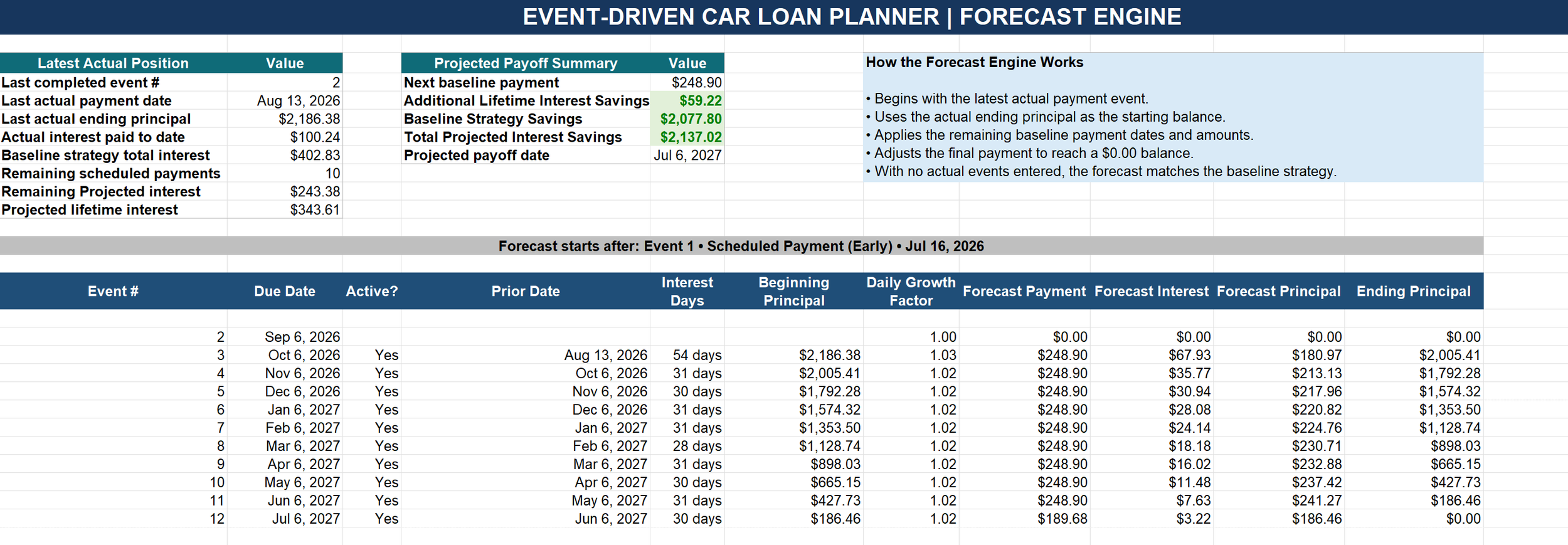
The Forecast Engine extends the workbook beyond traditional loan calculators by projecting the remaining repayment schedule, payoff date, and lifetime interest after each actual payment event. Starting from the latest recorded loan position, it dynamically recalculates future payments and quantifies the long-term financial impact of payment timing and amounts.